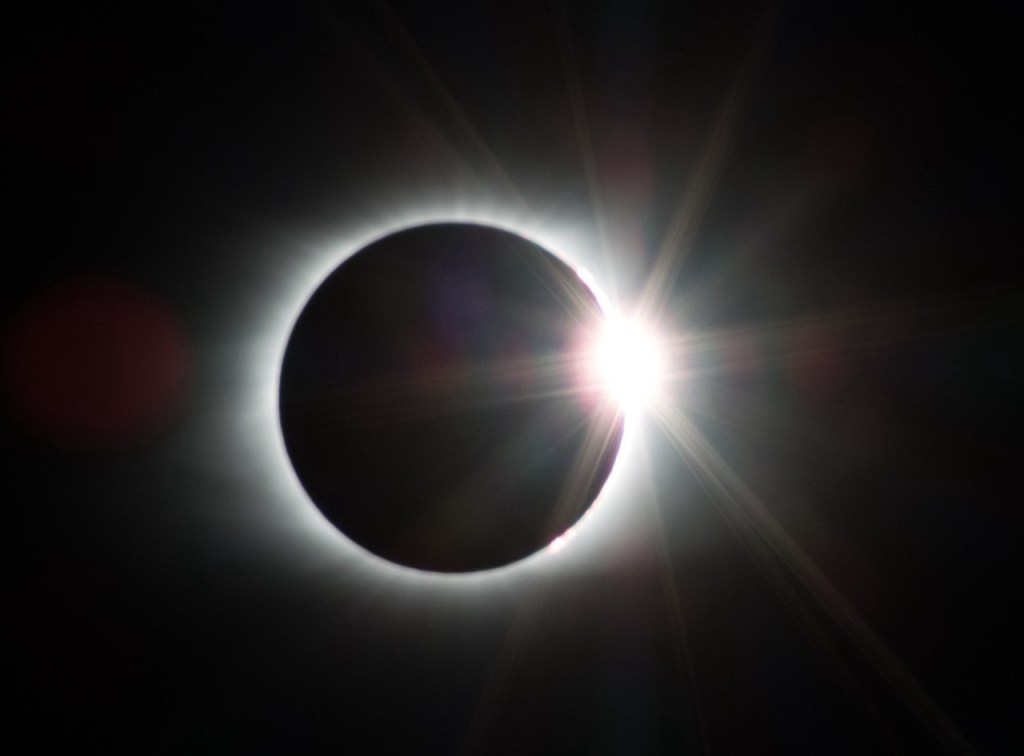
(Featured Photo courtesy of Danehrr22 via Pixabay)
Solar Eclipses happen all over the world, throughout the year, almost every year, somewhere. In fact, humans first recorded one of these spectacular celestial events on Nov 30th of 3340 BCE, in Ireland.
YES, you read that right – 3340 BCE!
Since ancient times, solar eclipses have held various beliefs and significance across different cultures. Here are some examples of beliefs and rituals surrounding solar eclipses throughout various cultures:
In ancient Chinese culture, the belief was that a solar eclipse occurred when a celestial dragon devoured the sun. To ward off the dragon and restore balance, people would make loud noises, such as banging pots and drums, to scare away the dragon.
In ancient Mesopotamian cultures, solar eclipses were seen as omens of potential disaster for the king or ruler. Rituals involving the king temporarily abdicating the throne or symbolic mock rituals were performed to protect the ruler from harm.
In ancient Greece, solar eclipses were often associated with myths and stories. The Greek historian Herodotus wrote about how the Medes and the Lydians stopped fighting during a solar eclipse in 585 B.C., believing it was a sign from the gods.
Various Native American tribes had their own interpretations of solar eclipses as well. Some saw them as a disruption in the natural order, while others viewed them as a time for reflection and spiritual renewal. Rituals involving prayer, fasting, and communal gatherings were common during eclipses.
In Hindu mythology, a demon named Rahu is said to swallow the sun during a solar eclipse. Hindus believe that performing religious ceremonies, such as taking a ritual bath or chanting mantras, during an eclipse can help protect against negative influences and ensure spiritual cleansing.
In Japanese culture, solar eclipses were traditionally seen as a time of prayer and purification. People would avoid eating during an eclipse and would engage in rituals to cleanse themselves of impurities and negative energies.
The ancient Maya possessed advanced astronomical knowledge and accurately predicted solar eclipses. They believed that solar eclipses were a time of great change and transformation, often holding ceremonies and rituals to appease the gods and ensure the continuation of the cosmic order.
So, in the examples above, we learned about the differences and some similarities in the beliefs and customs related to solar eclipses in various cultures. Each culture’s understanding of eclipses shows its own special beliefs about the universe, myths, and traditions.
But nowadays, modern humans can give a HUGE thanks to modern Science, as we now have a clearer understanding of the astronomical reasons behind solar eclipses, which helps us to dispel many superstitions and myths associated with them. This knowledge helps us to demystify eclipses and reduce the confusion, fear, and apprehension surrounding these mystical celestial events.
Scientific advancements also help us to predict solar eclipses accurately, letting us know in advance when and where an eclipse will happen and by sharing precise information about solar eclipses, we can raise awareness and promote education about these natural events.
Some traditional beliefs and rituals surrounding solar eclipses have evolved to incorporate modern scientific knowledge. For example, communities may still engage in traditional ceremonies during an eclipse but with an added scientific understanding of the event. In some cases, cultural practices have integrated scientific explanations into their rituals. This blending of traditional beliefs with scientific understanding reflects a more nuanced approach to interpreting natural phenomena.
While modern science has influenced traditional beliefs, many cultures do continue to maintain their unique customs and rituals related to solar eclipses as these traditions often serve as a link to cultural heritage and identity, even as scientific knowledge advances.
Overall, the influence of modern scientific explanations of solar eclipses has helped bridge the gap between tradition and science, leading to a deeper appreciation of these celestial events while also promoting a more informed and rational perspective among communities.
On a personal note, if I had to pick a belief to side with, it would be the one that embraces the power of positivity and the infinite possibilities that are available to us at every moment of our lives.
Today’s solar eclipse is a truly magical event that brings together diverse cultures and their unique perspectives. I invite you to share your theories or beliefs about today’s celestial phenomenon. Let’s celebrate the beauty of different perspectives from around the world! Please, feel free to drop a line and join the conversation.
Thanks for reading and may the force be with you on Solar Eclipse Day 2024!
Check out the LIVE STREAM from NASA : SOLAR ECLIPSE 2024
😉🌚♥️✨
 Archaic Rituals
Leave a comment